
What made the 2014 World Cup in Brazil special?
The 2014 FIFA World Cup was the twentieth edition of the men’s tournament and Brazil’s second time as host after 1950. FIFA’s archive records 32 teams, 64 matches, 171 goals and twelve venues. The competition opened in São Paulo on 12 June and ended with the final at Rio de Janeiro’s Maracanã on 13 July.
For travellers, the tournament was unusually geographic. Matches were spread across a country the size of a continent, from Manaus in the Amazon to Porto Alegre in the far south. That gave millions of viewers a rapid introduction to very different versions of Brazil — beaches, megacities, colonial centres, Amazonia and the modernist capital.
On the pitch, Brazil 2014 combined attacking football with dramatic upsets. Defending champions Spain went out in the group stage, Costa Rica reached the quarter-finals, Colombia had its best World Cup run at the time, and Germany ultimately became the first European nation to win the men’s World Cup in the Americas.
The twelve host cities and stadiums
Brazil deliberately spread the World Cup across twelve host cities. That created demanding travel logistics, but it also made the tournament a national event rather than one concentrated in Rio and São Paulo.
Rio de Janeiro · São Paulo · Belo Horizonte
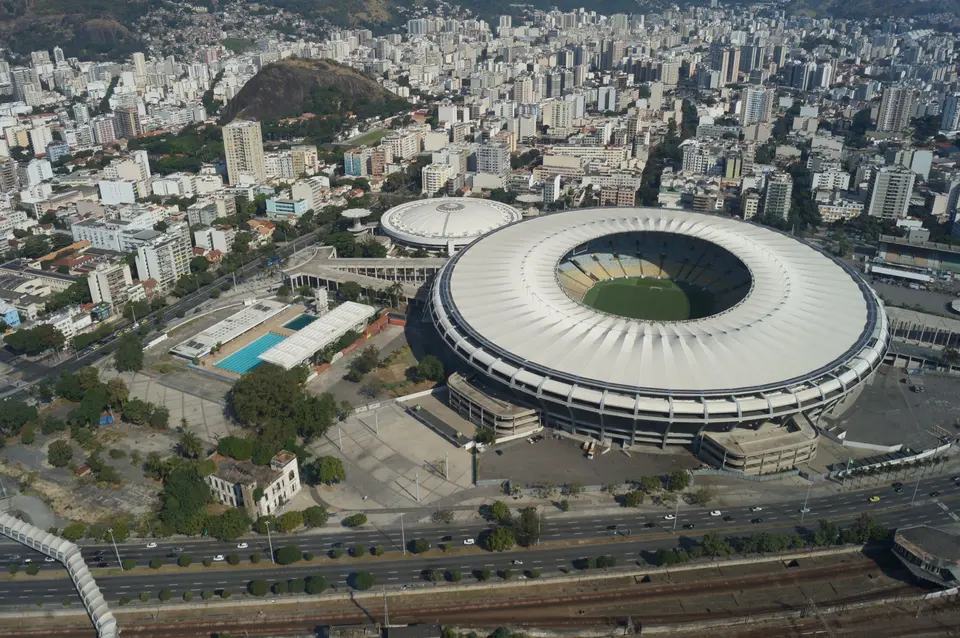
The Maracanã hosted the final, Arena de São Paulo staged the opening match, and Mineirão became forever associated with the Brazil–Germany semifinal.
Salvador · Recife · Fortaleza · Natal
Four coastal hosts connected the tournament with some of Brazil’s strongest beach, food and cultural destinations.
Manaus · Brasília · Cuiabá
Arena Amazônia brought the World Cup into the Amazon, while Brasília and Cuiabá extended the map into Brazil’s interior.
Porto Alegre · Curitiba
The two southern hosts showed a cooler, more temperate side of Brazil and completed the tournament’s huge geographic spread.
Several former hosts are already part of Brasilll’s destination collection, including Rio de Janeiro, São Paulo, Salvador, Fortaleza, Brasília and Manaus & the Amazon.
Brazil’s tournament: hope, Neymar and the 7–1
Brazil entered its home World Cup under enormous pressure and opened with a 3–1 win over Croatia. The hosts topped Group A, then survived a tense round-of-16 match against Chile on penalties. A 2–1 quarter-final victory over Colombia put Brazil into the last four, but Neymar suffered a back injury that ended his tournament. Captain Thiago Silva was also suspended for the semifinal.
What followed at Mineirão in Belo Horizonte on 8 July became one of the defining matches in football history: Brazil 1–7 Germany. Germany led 5–0 after only 29 minutes and eventually scored seven. Miroslav Klose’s goal also took him past Ronaldo as the all-time leading scorer in men’s World Cup history at that moment.
The score became cultural shorthand in Brazil. It was not merely an elimination; it was the heaviest defeat Brazil had suffered at a World Cup and a result still referenced simply as the “7–1”. Brazil then lost the third-place match 3–0 to the Netherlands.
The match condensed the pressure of hosting, Brazil’s football identity and a spectacular sporting collapse into ninety minutes. It is impossible to tell the story of Brazil 2014 without it — but the tournament was much larger than one result.
Germany’s fourth title and the Maracanã final
Germany’s route included a 4–0 opening win over Portugal, a difficult extra-time round-of-16 victory over Algeria, a 1–0 quarter-final against France and the extraordinary semifinal in Belo Horizonte.
The final on 13 July was completely different. Argentina and Germany were still level after ninety minutes at the Maracanã. In the 113th minute, substitute Mario Götze controlled André Schürrle’s cross and volleyed the winner past Sergio Romero. Germany won 1–0 after extra time and lifted its fourth World Cup trophy.
The victory also made Germany the first European team to win a men’s World Cup staged in the Americas. Argentina finished runner-up and the Netherlands third.
Players and moments that defined Brazil 2014
The tournament produced more than the host nation’s story. Colombia’s James Rodríguez scored six goals to win the Golden Boot and announced himself to a global audience, including a spectacular volley against Uruguay at the Maracanã. Lionel Messi led Argentina to the final and received the Golden Ball as the tournament’s best player, while Germany’s Manuel Neuer won the Golden Glove.
Other images became part of World Cup history: Spain’s early elimination after arriving as defending champion, Costa Rica unexpectedly topping a group containing Uruguay, Italy and England, Luis Suárez biting Giorgio Chiellini, Brazil’s emotional quarter-final against Colombia and the contrast between the chaotic semifinal and the tight, tactical final.
That combination is why Brazil 2014 remains so easy to remember: there was no single narrative. It was simultaneously Brazil’s home tournament, Germany’s triumph, Messi’s near miss, James Rodríguez’s breakthrough and a month of football spread across twelve very different Brazilian cities.
From the original Brasilll World Cup archive
The original Brasilll site followed the road to Brazil 2014 for several years and then published extensively during the tournament: stadium profiles, host-city notes, previews, squads, match reports and the final. Those articles were written for a live event, so republishing them unchanged more than a decade later would create an outdated and fragmented experience.
Brasilll 2.0 therefore consolidates that coverage here. Relevant historical URLs now point to this guide, preserving the context and any useful link authority while giving readers one maintained overview. Evergreen destination articles are handled separately when a modern city page is the better answer.
Preserve the useful history, not the old publishing format. A visitor arriving through a 2014 stadium or match-report link should understand what the event was and where that moment fits in the larger story.
2014 FIFA World Cup in Brazil FAQ
Who won the 2014 FIFA World Cup in Brazil?
Germany won the tournament, beating Argentina 1–0 after extra time in the final at the Maracanã in Rio de Janeiro. Mario Götze scored the winning goal in the 113th minute.
What happened in Brazil’s 7–1 defeat to Germany?
Germany beat host nation Brazil 7–1 in the semifinal at Mineirão in Belo Horizonte on 8 July 2014. Germany scored five times in the first 29 minutes and reached the final.
How many cities hosted the 2014 World Cup?
Twelve Brazilian cities hosted matches: Belo Horizonte, Brasília, Cuiabá, Curitiba, Fortaleza, Manaus, Natal, Porto Alegre, Recife, Rio de Janeiro, Salvador and São Paulo.
Who was the top scorer at Brazil 2014?
Colombia’s James Rodríguez won the Golden Boot with six goals.
Where was the 2014 World Cup final played?
The final was played at the Maracanã in Rio de Janeiro on 13 July 2014. Germany defeated Argentina 1–0 after extra time.
Sources & further reading
This is a historical guide. Tournament facts are checked against FIFA’s official archive and retrospective coverage.
- FIFA+ — 2014 FIFA World Cup Brazil archive — Official tournament archive: teams, matches, goals and memorable games.
- FIFA — Germans reign as Brazil thrills the world — Official post-tournament summary and individual awards.
- FIFA — Brazil 1–7 Germany — Official retrospective of the historic semifinal.
- FIFA — World Cup champions — Official winners summary for Brazil 2014.
Found an outdated price, route or detail? Send the page URL, the information that needs changing and a supporting source if available.
Report an error →